

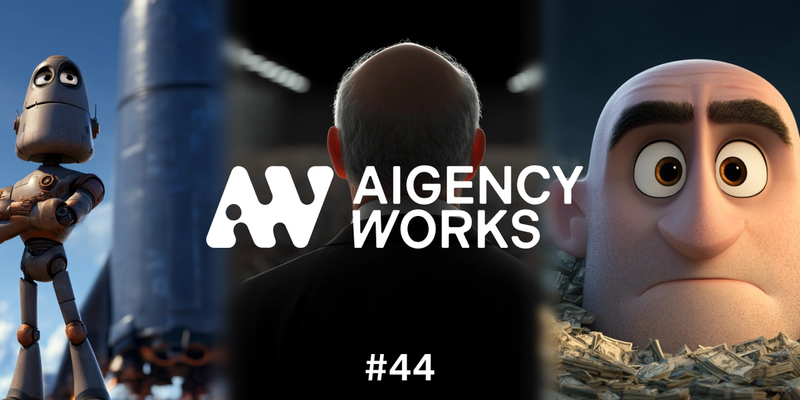
Anthropic-SpaceX deal, OpenAI wealth & O'Leary's AI pick
8th May
Welcome to The Aigency Works Dispatch, your backstage pass to what's fresh, fascinating, and flying off the innovation shelves in the world of AI. From breakthrough tools to bold new use cases, we're serving up bite-sized updates to keep you (and your Aigents) ahead of the curve. Let's dive into what made waves this week
Three Comma Collaboration: Anthropic and SpaceX team up
Anthropic has officially crossed a $1 trillion valuation, becoming only the third private company in history to hit that number alongside OpenAI and SpaceX. To put that in perspective, most countries have a smaller GDP. The company that started as a safety-focused AI lab founded by a group of former OpenAI researchers has, in a few short years, gone from underdog to one of the most valuable businesses on the planet without ever going public. The milestone lands as enterprise demand for Claude continues to surge, and follows the company's reported $30 billion revenue run rate that put it ahead of OpenAI earlier this year. At this point the IPO question isn't really "if" anymore.

To be clear, a valuation is not the same as revenue, profit, or a guarantee of anything. It's a number investors agree on, and in the AI space right now those numbers are moving fast and loose. That said, crossing the trillion mark does something beyond the spreadsheet. It signals that the market views Anthropic as a long-term pillar of the industry rather than a well-funded challenger. For a company that has always positioned safety and responsibility as its core product, the pressure that comes with a valuation like this will be worth watching closely. Big numbers bring big expectations, and big expectations have a way of stress-testing principles.
Source: Bloomberg / Financial Times — 'Anthropic Valuation Crosses $1 Trillion in Latest Funding Round'
WATTS THE PLAN?

A proposed hyperscale data center backed by investor Kevin O'Leary is being planned for northern Utah, and the numbers attached to it are the kind that make utility companies go very pale very quickly. If approved and built to the scale proposed, the facility could consume more than double the entire state of Utah's current electricity usage. Just to run servers. The project is framed as critical AI infrastructure, the kind of large-scale compute facility needed to keep pace with demand. Policymakers, residents, and scientists in the region are not entirely convinced, and a pretty significant debate has broken out about whether the infrastructure benefits outweigh the strain on the grid, water supplies, and local energy costs.
This story is a useful grounding moment in a conversation that often stays very abstract. AI progress is real and the applications are genuinely exciting, but the physical footprint required to run it at scale is enormous and growing fast. Data centers don't run on enthusiasm. They run on water for cooling and vast amounts of electricity, and both of those things have to come from somewhere. The Utah proposal puts that reality in front of a community that didn't ask to be at the center of the AI buildout. Whatever happens with this specific project, the tension between AI infrastructure demand and local resource limits is a story that is going to keep coming up in a lot of different places.
Source: Salt Lake Tribune / Reuters — 'Kevin O'Leary Backed Data Center Proposal Would Use Twice Utah's Current Electricity'
Brockman's Big Bucks

Greg Brockman, co-founder and president of OpenAI, disclosed in court this week that his personal stake in the company is currently valued at close to $30 billion. The disclosure came as part of ongoing legal proceedings and was notable less for the number itself and more for the window it opens into just how much wealth has accumulated at the top of the AI industry in a remarkably short period of time. Brockman is one of the original architects of OpenAI, having been there from the very beginning, and his stake reflects years of equity in a company that has gone from nonprofit research lab to one of the most talked-about businesses on earth.
The figure is striking but worth contextualising. Like all private company valuations, it is theoretical until there is a liquidity event, meaning an IPO or acquisition where shares can actually be sold. OpenAI has not gone public. That said, secondary markets for pre-IPO shares in companies like OpenAI are active and the valuations are taken seriously by serious investors. What the disclosure really does is give the public a rare, court-mandated glimpse into the economics of being on the ground floor of a generational technology shift. The AI boom has created extraordinary paper wealth at the top. The more interesting question, as always, is what comes next and when any of it actually becomes real money.
Source: Court filings / The Wall Street Journal — 'OpenAI President Greg Brockman Discloses $30 Billion Stake in Court Proceedings'