

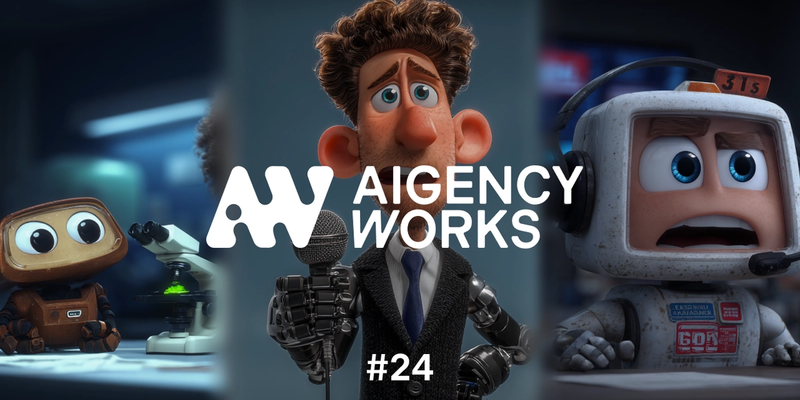
AI News Reporters, AI Fraud Schemes, and the AI Sandbox Era
24th October
Welcome to The Aigency Works Dispatch, your backstage pass to what's fresh, fascinating, and flying off the innovation shelves in the world of AI. From breakthrough tools to bold new use cases, we're serving up bite-sized updates to keep you (and your Aigents) ahead of the curve. Let's dive into what made waves last week
Read All A-Bot It
Channel 4 just pulled off a plot twist worthy of its own Dispatches documentaries - unveiling the UK’s first ever AI-generated presenter in its latest episode, “Will AI Take My Job?” The programme set out to explore how automation is reshaping industries across Britain, from journalism and law to logistics. But the real headline came at the end: the host wasn’t human at all. The network revealed that the presenter had been created entirely by AI - script, voice, expressions and all - in an experiment designed to test how convincingly artificial intelligence could front a serious piece of journalism.

Behind the spectacle sits a bigger question about where storytelling goes next. Channel 4 said the move was meant to spark debate about how fast the technology is evolving, and what happens when audiences can no longer tell the difference between human and synthetic. Some see it as a creative breakthrough, others as a warning shot for broadcasters and journalists alike. Either way, it’s a watershed moment for UK television - proof that even the most human craft of all, storytelling, is now sharing the spotlight with silicon.
AI Fraud?

Cracking the vault of nuance: the UK’s fraud landscape has just had a major plot twist, courtesy of AI. According to UK Finance, fraud losses in the first half of 2025 hit over £629 million, with criminals increasingly deploying AI-powered tools like deep-fake videos, fake dashboards and SMS “blasters” to scale scams at lightning speed. Investment fraud shot up 55 % (nearly £100 million lost) and romance scams climbed 19 % in volume and 35 % in losses. And it’s not just the crooks innovating: banks used advanced AI systems to block £870 million of unauthorised fraud - a 20 % improvement on last year.
But beneath the figures sits a bigger question: do we now live in a world where sophisticated AI isn’t just generating cute cat memes, but also forging phishing schemes and impersonating voices? The arms race is here. Financial firms are playing catch-up, and the tech is evolving so fast it’s more “what can we stop next?” than “what just happened?” The message is plain: automation doesn’t always mean productivity gains - it can also mean threat escalation. For professionals, it’s time to treat AI not only as a tool for efficiency but also as a battleground for defence.
Welcome to the AI Sandbox

The UK just cracked open the lid on its next big AI experiment. The Department for Science, Innovation and Technology has proposed a cross-economy “AI Growth Lab” - basically a national sandbox where cutting-edge AI systems can be tested under relaxed rules. The plan, announced on 21 October, invites businesses and builders to jump in, signalling the government’s shift from cautious regulation to “let’s see what this thing can really do” - while still keeping one hand firmly on the safety lever.
The idea is simple: let sectors like healthcare, transport and manufacturing trial new AI tools in the wild before the rulebook gets rewritten. By gathering real-world evidence, policymakers hope to spark faster innovation and keep the UK competitive in the global AI race. But loosen the guardrails too much, and the question becomes: who’s actually steering? For startups and founders, this could be the green light to experiment - but it’ll also demand sharp ethics, quick compliance reflexes, and the ability to play nicely inside a “live lab.” The next wave of AI growth might belong to those brave enough to test it while the paint’s still drying.